Finalist Award · 2021 MCM/ICM Mathematical Contest in Modeling
Team Member · Qing He · Ruiqing Hu · Liang Yin
Tools Python · NetworkX · scikit-learn · Pandas
Full paper you can find here.
Overview
Quantifying the Unmeasurable
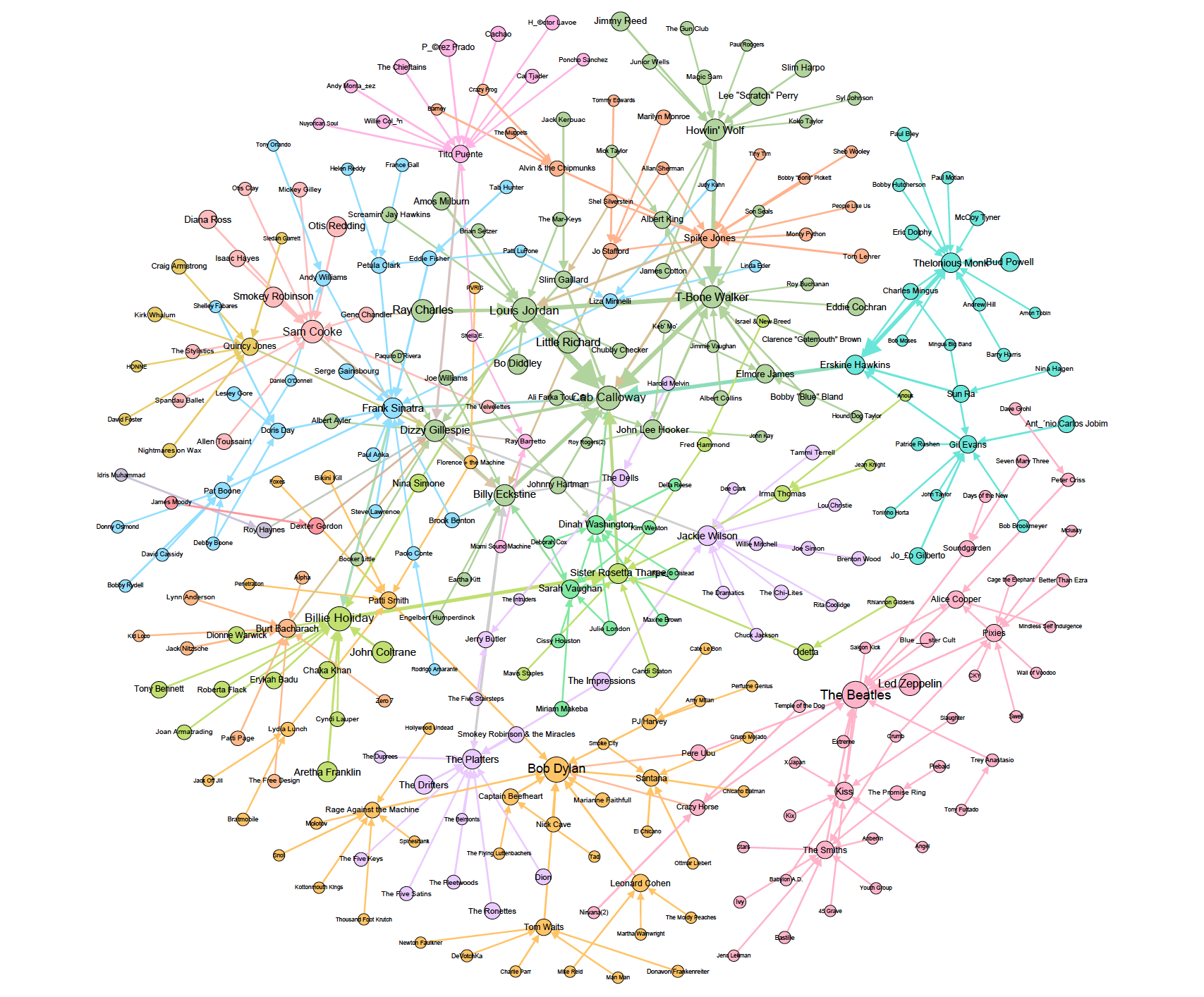
Most accounts of musical evolution rely on narrative: critics, anecdote, history books. This project takes a different approach by treating the relationships between musicians as a directed graph, where every edge encodes who influenced whom, and every node carries an 11-dimensional acoustic feature vector.
The central question: can we move beyond subjective claims and rigorously model how influence propagates, which genres are truly distinct, and when musical revolutions actually occurred?
Four Interlocking Models
Rather than a single algorithm, this project chains four models together - each feeding into the next.
Modified PageRank
Standard PageRank adapted for music influence, with damping factor q = 0.3 (vs. the web’s 0.85). The key insight: musical followers becoming influencers themselves is far less probable than web browsing chains. A lower damping factor reflects that creative influence dissipates more quickly than hyperlink traversal.
Entropy-Weighted Similarity
Feature weights derived via Information Entropy (EWM) across 11 acoustic dimensions — danceability, energy, valence, tempo, loudness, acousticness, instrumentalness, liveness, speechiness, mode, and key. The principle: higher entropy in a feature → higher discriminative power → higher weight. Similarity is then the inverse of the Weighted Euclidean Distance between two artist vectors.
Hierarchical Clustering + PCA
Complete-linkage hierarchical clustering groups all 20 genres into 4 macro-clusters. PCA reduces the feature space to 3D for visualization. The surprising finding: instrumentalness and speechiness are the primary axes separating genres — not the more intuitive energy or tempo.
Dynamic PageRank
Extends the base model by weighting each influence edge with two dynamic indices: θ_time (temporal distance between artists’ active periods) and θ_genre (cross-genre musical distance). Artists who transcend both era and genre rank higher as “dynamic influencers”, a more nuanced measure than raw follower count.
Key Findings
After running the full model pipeline across 5,603 musicians and ~42,000 influence edges, five results stood out.
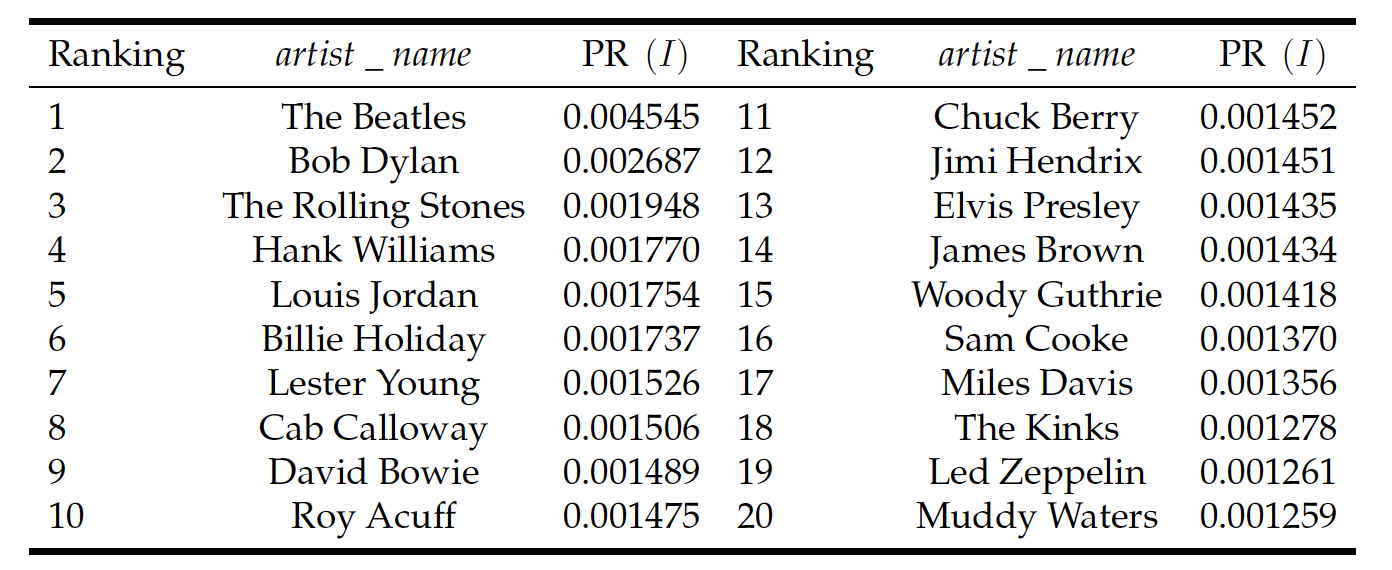
Influence follows a power law. A handful of artists, such as The Beatles, Bob Dylan, Hank Williams, account for a disproportionate share of total network influence, consistent with scale-free network behavior. The top 20 artists by PageRank collectively shape the trajectories of thousands of followers.
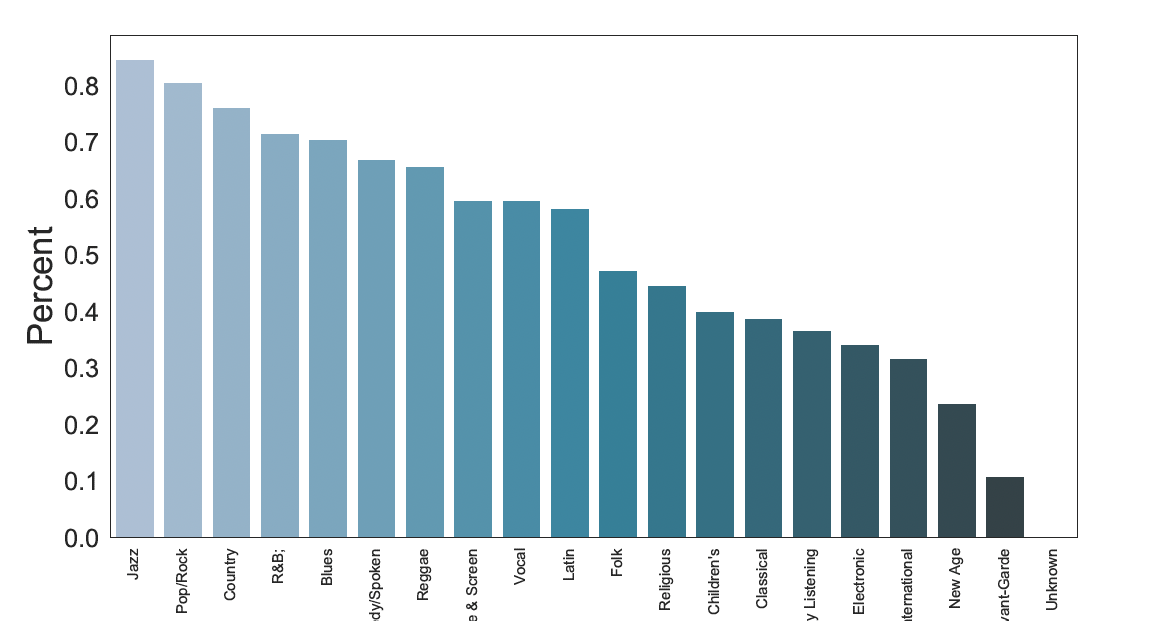
Mainstream genres self-reinforce; niche genres borrow. Jazz, Pop/Rock, and Country receive 70%+ of their influence from within their own genre. Electronic, New Age, and Avant-Garde draw less than 40% internally, actively absorbing from adjacent styles. Established genres have stable identities; emerging ones are still searching for one.
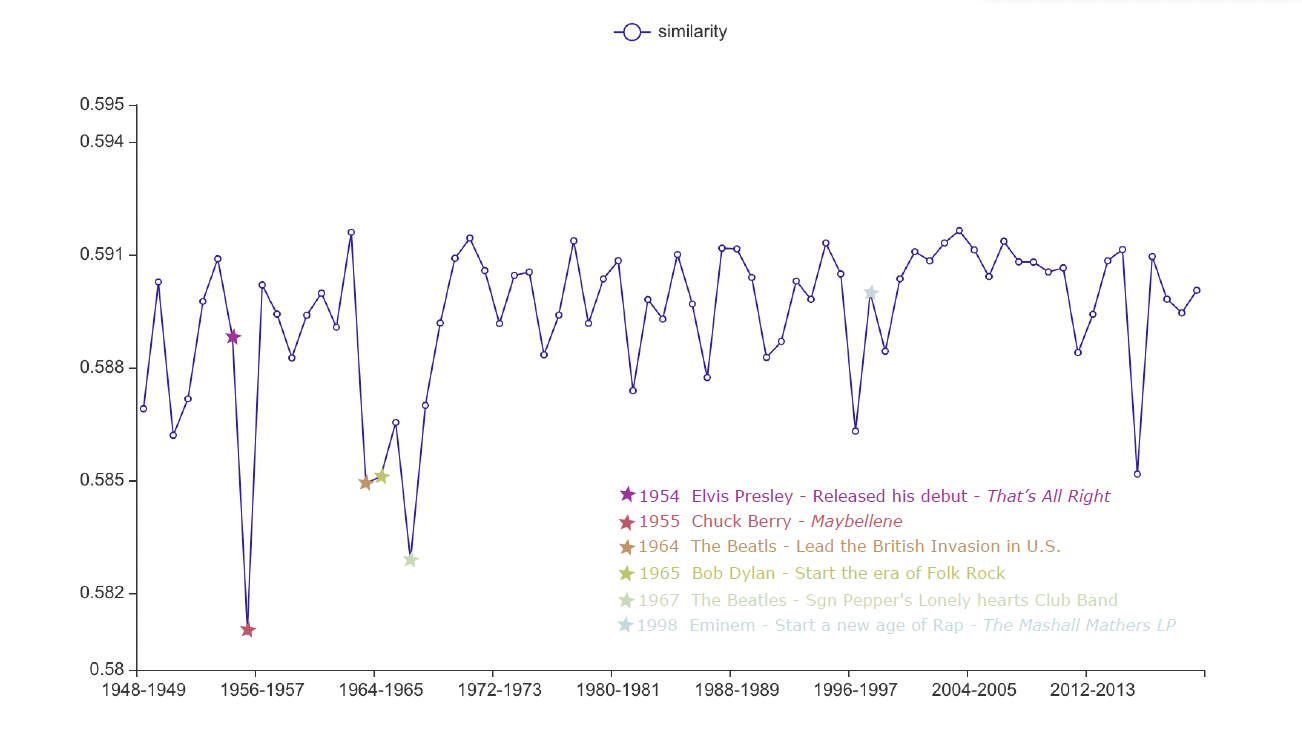
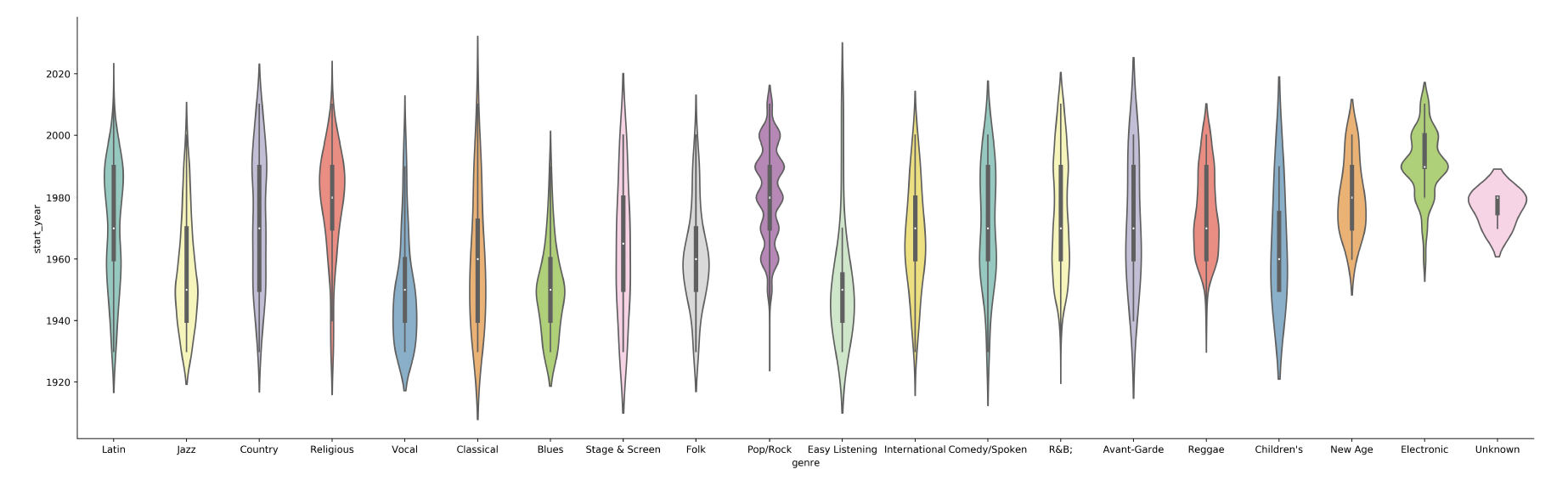
Three musical revolutions, verified quantitatively. Similarity-over-time analysis pinpoints the 1950s Rock & Roll emergence, the 1960s British Invasion, and 1980s contemporary R&B as moments of maximal stylistic discontinuity. These align precisely with known historical events, which means that the model independently recovered what music historians already knew.
Influencers don’t always convert followers. Only 52.4% of followers show increased musical similarity to their influencer’s style over time. The other 47.6% diverge. Imitation and divergence coexist as creative strategies, and the data can’t fully distinguish which is which.
Genre identity lives in two dimensions. Of all 11 acoustic features, speechiness and instrumentalness show the largest gap between genre clusters. Energy and tempo, which most people intuitively associate with genre, are comparatively weak discriminators.